


A company man does not need a capabilities deck to know how a water transfer contractor is going to run a job. He needs to walk the location. Long before anyone opens a bid sheet, the way the lines are laid, the way the pumps are staged, and the way the valves are labeled tell him almost everything about the crew that put them there.
That is not superstition. In frac water transfer, appearance and performance come from the same place: discipline. A location that looks orderly is a location that was set up by people who think in terms of what happens when something goes wrong — and that is exactly the crew you want moving water on your completion.
Here is what a well-run water transfer contractor’s location actually looks like, and why the details you can see predict the ones you can’t.
The location is the resume
Everything else a contractor tells you is a claim. The location is evidence.
You cannot see a company’s safety record from the highway. You cannot see whether they permitted their crossings on time or whether someone is actually awake watching the system at three in the morning. But you can see how they lay a line. And the crews that run a clean, square, deliberate location are — with remarkable consistency — the same crews that did the invisible parts right.
That is why an experienced buyer reads a site the way a mechanic listens to an engine. The finish tells you about the build.
Straight lines are not cosmetic
There is a temptation to treat a tidy location as vanity — nice to look at, not worth paying for. That gets it backwards.
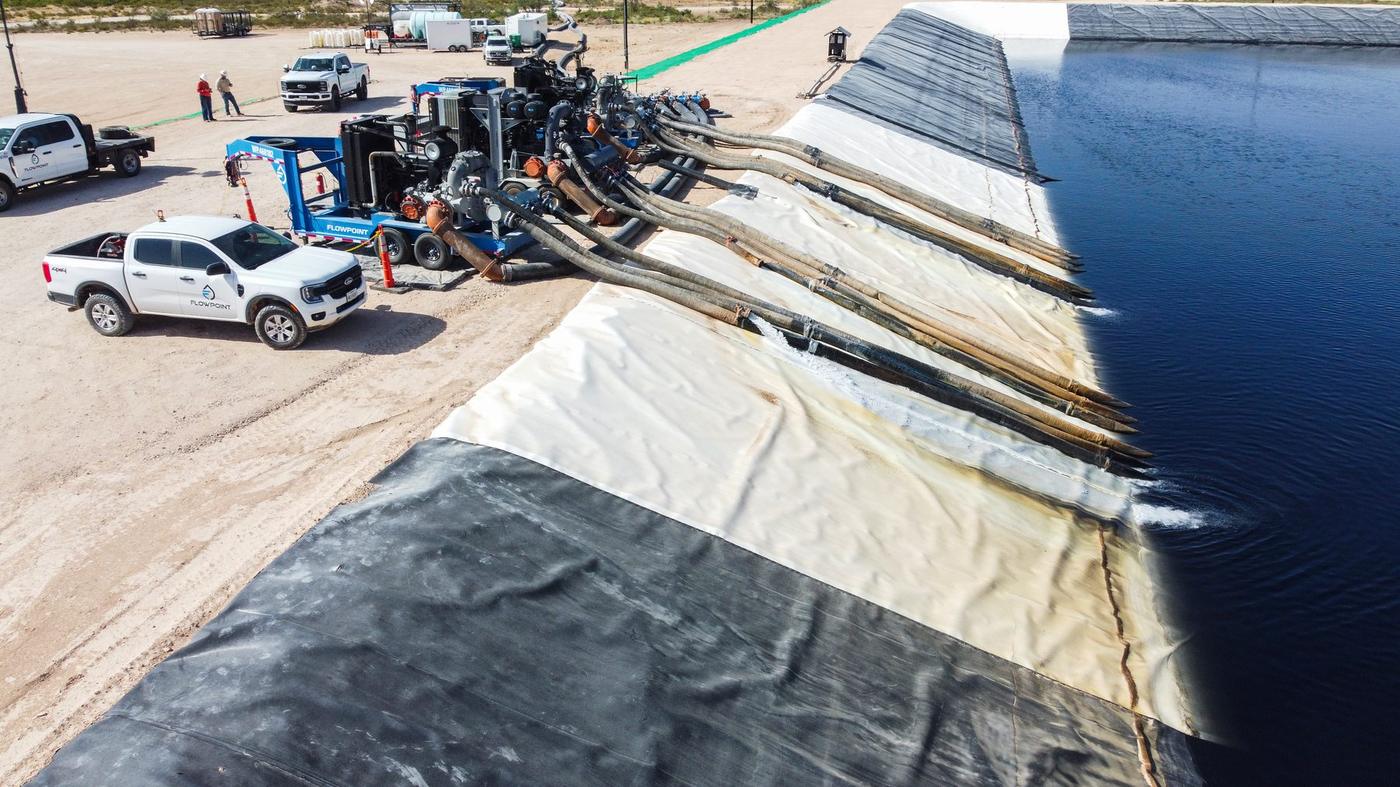
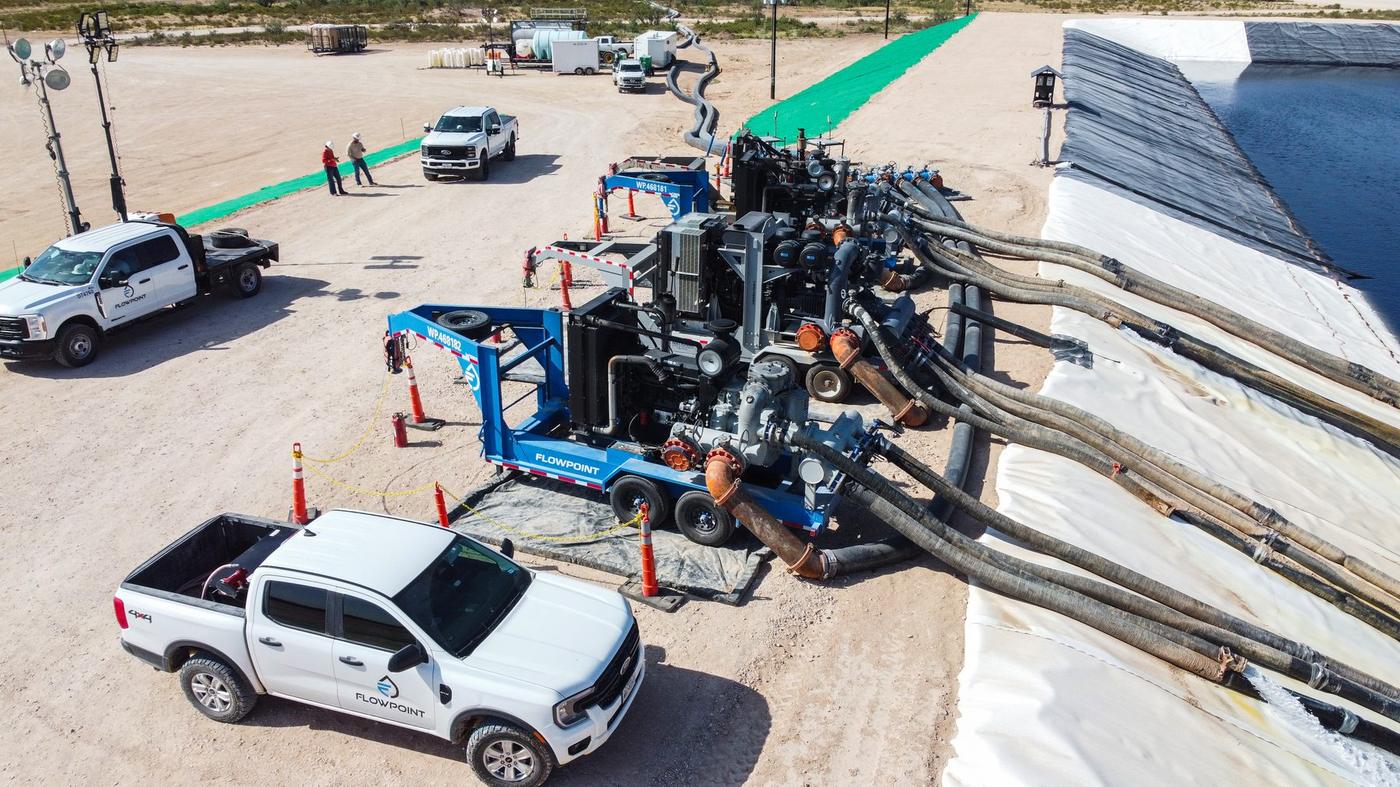
Lines run straight and parallel along the berm are easier to inspect, easier to walk, and easier to isolate when one has to come out of service. Pumps staged square on their containment mats, with suction runs at consistent angles, are pumps a crew can work around at night without tripping over a problem someone created in daylight. Valves labeled and capped ports flagged mean the next person to touch the manifold knows what is live and what is not before they turn anything.
Precision is not decoration on a transfer spread. It is how the system stays workable for the weeks it has to run. A straight line is a functional line. A crew that lays one is a crew that torques the flange, chocks the equipment, and preserves landowner access because all of it comes from the same habit of doing the thing correctly the first time.
What sloppy costs
The opposite is just as legible, and it is not free.
Lines snaked across the ground at random are lines nobody can trace at speed when a reading moves the wrong way. Equipment crammed in wherever it landed is equipment a crew fights to service in the dark. An unlabeled manifold is a mistake waiting for the one shift where the person who set it up is off.
None of that shows up as a line item. It shows up later — as the extra hour finding a problem, as the pump that gets serviced late because nobody could get to it, as the reportable event that traces back to a valve someone opened thinking it was capped. On a completion where water starving the frac brings down several crews at once, minutes are expensive. Sloppy is a slow leak in the schedule.
Why appearance tracks with performance
The reason the location predicts the job is that both are produced by the same people, under the same standard, on the same day.
A crew does not hold two standards — a careful one for the parts a buyer can see and a loose one for the parts he cannot. The habit that lays a straight line is the habit that runs redundancy instead of the bare minimum: more than one line so losing one is a capacity hit and not a stopped frac, more than one pump so a mechanical failure stays an inconvenience, a manifold built so a line can come out of service without shutting anything off. Continuous monitoring like Scorpion™ is watching the system every hour — but the discipline to install it cleanly and respond to it correctly is the same discipline you saw the moment you drove up.
That is the entire argument. Pride in the work is not sentiment. It is the most reliable outward sign of a crew that designed for the failure instead of the average.
What to look for when you walk a location
If you are evaluating who moves water on your next completion, the walk-around answers more than the sales call. Four things to look at:

- Are the lines run straight and parallel, or snaked at random? Order means someone planned the layout before they built it. Random means they reacted.
- Is the equipment staged square and serviceable? Ask yourself whether a crew could get to that pump at 3 a.m. without moving three other things first.
- Is the manifold labeled, with unused ports capped and flagged? A switchboard nobody can read is an outage looking for a shift to happen on.
- Does the location look like anyone is proud of it? It is the softest signal and one of the most reliable. Crews that take pride in how a job looks tend to take pride in how it runs.
None of these require a technical background to see. They are visible from where you are standing.
The bottom line
Frac water transfer is judged by one standard, and it is not throughput — it is whether water was ever the reason the job slowed down. You cannot verify that from a brochure. But you can read it, with surprising accuracy, in the way a contractor leaves a location.
Straight lines, square equipment, a labeled manifold, and a crew that clearly cares how the work looks are not cosmetic details. They are the visible edge of the discipline that keeps water arriving when the pumps are calling for it. When the finish is that good, the parts you cannot see usually are too.
Flowpoint Services handles water transfer, pit management, and continuous monitoring across the Permian Basin. If you have a completion coming up and want to walk through the water side of it, we are in Midland. Get in touch.
.svg)

