

If you’ve heard “automated water management” a dozen times at an industry conference and still aren’t sure exactly what it means on a job site, you’re not alone.
The phrase gets used to describe everything from a single remote sensor to a fully integrated monitoring and control system. The difference matters — especially when your frac schedule is running and your water transfer system is the only thing standing between you and a delay.
Here’s what automated water management actually means in the field, what it can and can’t do, and why it’s becoming the baseline expectation for Permian Basin completions.
The Problem With Manual Water Transfer
Traditional water transfer relies on scheduled checks. A crew monitors equipment at intervals, responds to problems when they’re reported, and adjusts based on what they observe on site. Skilled people on the pad are essential to that work — and that doesn’t change with automation.
The limitation isn’t the crew, it’s the gap between checks. A leak that develops between walk-downs can run for a while before anyone catches it. A pressure spike that builds gradually doesn’t trigger a response until it’s already a problem. In a high-volume frac environment, “we caught it at the next check” can mean real downtime and remediation costs — the frac crew sitting idle while the issue gets sorted out.
What Automation Actually Adds
Automated transfer replaces the gap between manual checks with continuous monitoring. In practice, that means:
- Real-time flow monitoring that registers a drop the moment it happens, not at the next walk-down.
- Automated pressure monitoring and control that holds the line within safe parameters and can adjust before a pressure event becomes a failure.
- Leak detection that flags the volume discrepancy between what enters the system and what’s delivered.
- A central data picture your operations team and ours can both see, in real time.
The common thread is speed. Automation shortens the window between a problem developing and someone knowing about it — which, on a frac job, is where the money is.
What Automation Doesn’t Replace
It’s worth being clear about this, because the marketing around automation often isn’t: it doesn’t replace an experienced crew. It gives them better information.
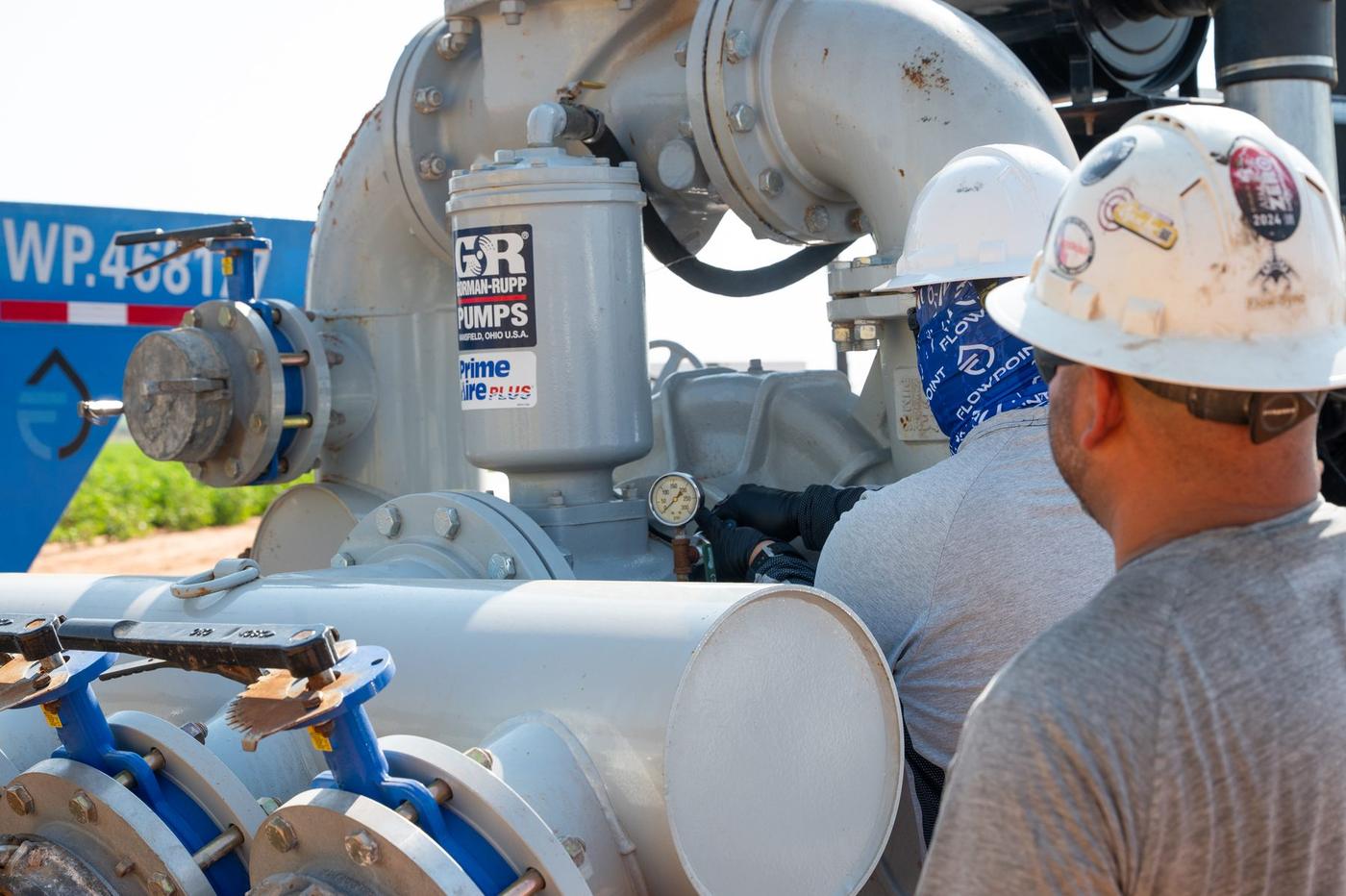
Our pumps are fully automated and can be controlled remotely — we can ramp a rate up or down without a hand on every valve. But we keep skilled people on site throughout the job, watching the equipment and the live data as it comes in. When a sensor flags something, someone is already there to read it, judge it, and act. Automation makes that person faster and better informed; it doesn’t make them optional. The system and the crew cover the job together, continuously — nothing is riding on the next scheduled walk-down.
That balance — technology handling the repetitive precision, people handling the judgment — is the part that actually works in the field.
Why This Matters in the Permian
The Permian is producing more water per well than at any point in its history. Longer laterals, more complex completions, tighter schedules. For every barrel of oil, operators commonly manage three to five barrels of water, and in mature fields that ratio climbs higher.
The cost of an unplanned transfer stoppage isn’t just the stoppage. It’s the frac crew standing down, the schedule compression that ripples downstream, and the scramble to recover. Automated transfer is one of the few places where a relatively small investment in monitoring meaningfully lowers the odds of an expensive day.
What to Look For in a Vendor
If you’re evaluating water transfer vendors, the questions worth asking are straightforward:
- What does your monitoring actually cover — flow, pressure, leak detection, tank levels?
- How is the data reported, and who sees it?
- What does the alert-and-response process look like when something goes wrong?
- What’s your crew’s response time to a field alert?
A vendor who answers those clearly has built the system, not just bought the brochure.
Flowpoint Services LLC provides automated water transfer, monitoring, treatment, and full-cycle water management for E&P operators across the Permian Basin and West Texas. To talk through your next completion, get in touch.
.svg)

